

Try it right now. You've got two minutes.
Explore breathing classes for stress.
Want to go deeper with your breathwork practice? Join Aska for a guided breathing class — available online and in Oxford.
What is the fastest breathing exercise for stress?
A 2 minute breathing exercise for stress works by extending the exhale longer than the inhale, which activates the vagus nerve and signals the nervous system to calm down in 60 – 90 seconds.
Your nervous system is reacting to danger. Here’s how to tell it you’re safe. Feeling stressed or overwhelmed? This simple 2-minute breathing exercise activates your nervous system’s off switch – no app or quiet room needed.
You are sitting in a meeting when your boss drops a bombshell. Or you’re stuck in traffic, already late. Or you receive a message that makes your stomach drop.
Nothing is physically chasing you. You are not running for life. But your body doesn’t know that.
In a matter of seconds, your brain’s threat-detection centre – the amygdala – fires an alarm signal that cascades through the hypothalamus and into the adrenal glands, flooding your system with epinephrine (adrenaline) and cortisol. Your heart rate shoots up, pumping blood away from your digestive organs and into your arms and legs. Your breathing becomes shallow and rapid. Your muscles tense. Your vision narrows. Your digestion pauses. Everything non-essential to immediate survival shuts down

This is the fight-or-flight response, and for our ancestors outrunning predators, it was perfect. The problem is that your nervous system cannot tell the difference between a lion and an approaching deadline. So, it does the same thing for both:
Both are valid, well-documented stress reactions rooted in sympathetic nervous system activation.
Not every type of stress is harmful.
Certain pressures are entertaining, energising, and motivating. These beneficial stressors, known as eustress, improve cardiovascular health, increase endurance, and improve cognitive function.
The problem starts when the stress response activates repeatedly in our fast-paced everyday life – it then becomes a chronic health issue.
The good news? There is a back door into that alarm system — and it has been with you your entire life – your breath.
Most of the autonomic nervous system – the one running your heart rate, digestion, and stress response – is completely outside conscious control. You cannot decide to lower your cortisol or will your heart to slow down.
But breathing is the exception. It is the only autonomic function you can consciously control, which makes it a direct line into your nervous system.
Here is the key mechanism: your exhale activates the vagus nerve, the longest nerve in your body and the primary highway of the parasympathetic nervous system (rest & digest state). The reason the exhale matters more than the inhale is physiological. When you inhale, your heart speeds up slightly. When you exhale, it slows down. A longer exhale means more time spent in that deceleration phase — the cardiovascular system repeatedly receiving the signal: the threat has passed. You are safe. Your body shifts out of high-alert mode and back toward calm. This is the principle behind vagus nerve breathing — and the reason a deliberate exhale can shift your state in under two minutes.
The science here is robust. A 2022 meta-analysis of 223 studies on slow-paced breathing found that voluntary slow breathing consistently increases vagally mediated heart rate variability (HRV) – a key biomarker of parasympathetic nervous system activity and stress resilience. A 2023 systematic review of 58 clinical trials of breathing practices for stress and anxiety found that 54 of 72 breathing interventions were effective in reducing stress and anxiety, with slow, extended exhale approaches showing the most consistent benefit.
A more recent 2025 review covering 30 studies found HRV improvements in 23, alongside reductions in cortisol, anxiety, PTSD symptoms, and improvements in emotional regulation.
Before you begin the full breathing method, there’s a single move worth knowing on its own: the physiological sigh. It’s something your body already does instinctively — that involuntary double-inhale you take after crying, or when you’ve been holding tension for too long. You’re just going to do it on purpose.
Repeat 1–3 times. You should already feel a small but distinct change. That’s your nervous system being told it’s safe to stand down. Now you’re ready to build on it. The physiological sigh can also be used as a 2 minute breathing exercise for stress when repeated for several breathing cycles.
You don’t need an app, a quiet room, or a meditation cushion. You can do this at your desk, in your car, or in a bathroom stall if that’s all you have.
Extended exhale breathing works on one simple principle: exhale for longer than you inhale. That’s it. The longer exhale activates the vagus nerve and signals safety to your brain. You don’t need a perfect ratio — you just need the out-breath to be noticeably longer than the in-breath.
Start with the physiological sigh above, then move into whichever level feels accessible right now:
Level 1 — Gentle start: Inhale for 2, exhale for 4
Level 2 — Building: Inhale for 4, exhale for 6
Level 3 — Full technique: Inhale for 4, hold for 2, exhale for 8
Aim for 2 minutes in total. Even at Level 1, you’re already activating the parasympathetic response — that’s enough. But if you push to 5 minutes and work up to Level 2 or 3, the benefits compound considerably. This 2 minute breathing exercise for stress works because the extended exhale signals safety to the brain.
The technique works best when practised during calm moments, so it becomes automatic under pressure. Try it in the morning before reaching for your phone, or as a wind-down before sleep. The more familiar the pattern feels at rest, the faster it will work when you need it most. The next time your stress response activates, try this 2 minute breathing exercise for stress to quickly reset your nervous system.
If 8 counts feels too long at first, start with a 2-4 ratio and build gradually. The exact numbers matter less than the principle: the exhale must be meaningfully longer than the inhale.
Your nervous system is not your enemy. It is ancient, fast, and trying to protect you. But with two minutes and your own breath, you can remind it – every single time – that you are okay. The next time your stress response activates, try this 2 minute breathing exercise for stress to quickly reset your nervous system.
Want to go deeper with your breathwork practice? Join Aska for a guided breathing class — available online and in Oxford.
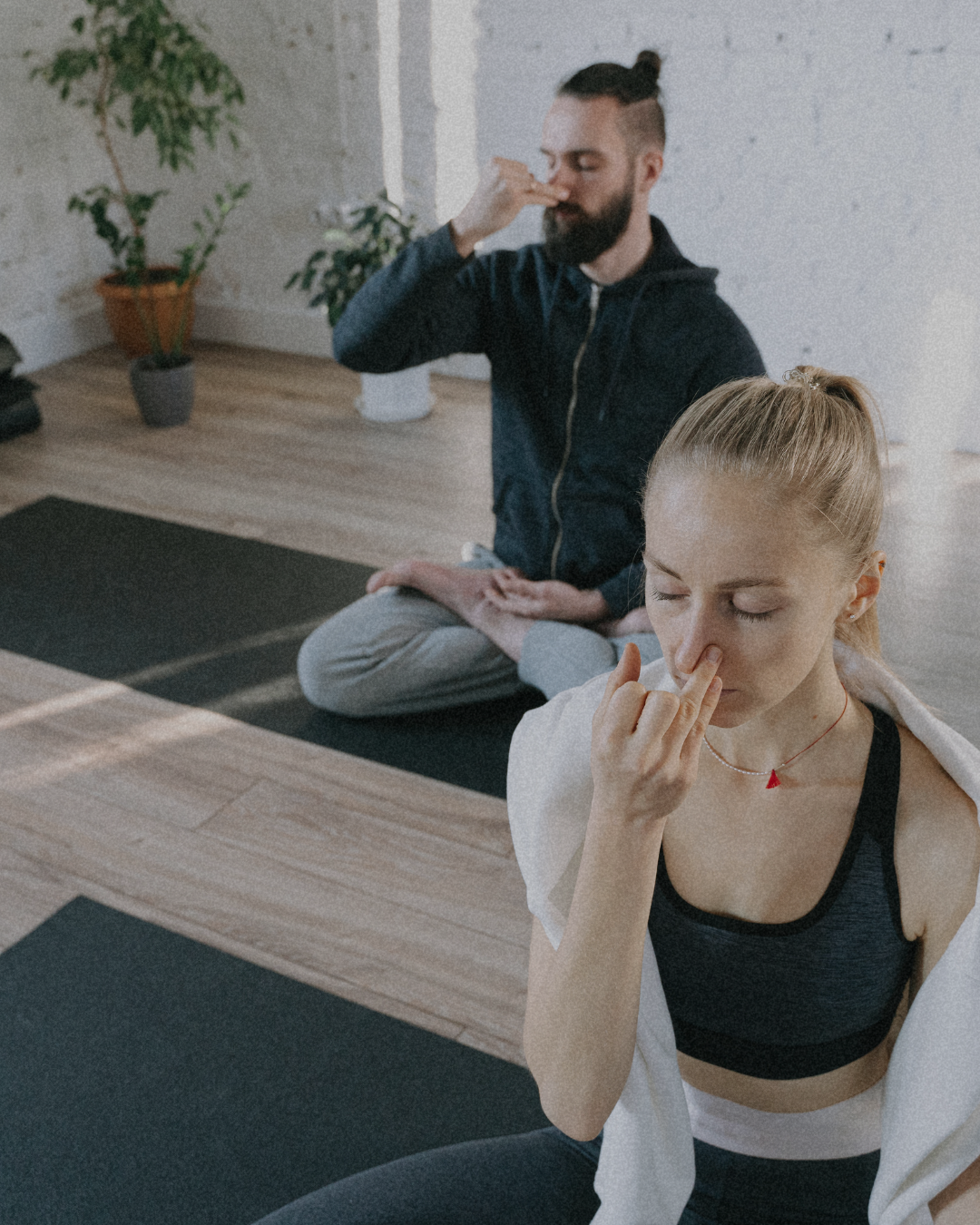
The physiological sigh is a double inhale through the nose, followed by a long, slow exhale — a pattern your body instinctively does after crying or holding tension. Used deliberately, it rapidly reduces CO2 buildup in the lungs by re-inflating collapsed air sacs (alveoli) and triggers an immediate shift toward calm.
A longer exhale activates the vagus nerve, extending the time your heart spends slowing down with each breath cycle.
Most people notice a shift within 60–90 seconds of starting, with the physiological sigh often creating an almost immediate change. Regular practice during calm moments makes the response faster and more reliable under pressure.
Yes — this technique is silent, requires no equipment, and works in any position. A desk, a car, or a bathroom cubicle all work perfectly, and nobody around you will notice a thing.
Breathing classes for stress teach you to use your breath intentionally to regulate your nervous system, with guidance that helps you build the habit properly. Working with an instructor means the techniques become automatic — so they’re there when you actually need them.